

What It Means to Design Growth (Rather than Manage It)
Most marketing teams don't have a growth problem. They have a design problem. Here's what that distinction means and why it changes everything.
 Skip to content
The lived reality of modern marketing leadership in South Africa is often defined by a quiet but persistent instability. Many leaders in mid-sized to enterprise organisations report a specific feeling of performance volatility. They observe campaigns that show significant early promise but then decline rapidly without a clear cause. Teams continuously optimise their individual channels. Yet, the overall momentum of the brand fails to compound. This instability often feels like a series of isolated execution failures. Competent professionals work harder, spending more on advertising and producing more content.
This pattern is not a reflection of team incompetence. Instead, it is the primary symptom of structural fragmentation. When competent execution produces unstable outcomes, the problem is rarely effort. It is architecture. This article will define what a marketing system actually is. We will then clarify what fragmentation means in a high-performance environment. The goal is to move beyond simple tactical fixes and understand the underlying architecture of growth.
South African businesses are currently navigating a complex economic landscape. Sluggish growth and policy uncertainty amplify pressure on marketing teams. Even strong execution can feel fragile in this environment.
One cannot understand fragmentation without defining the object being fragmented. A marketing system is a connected relationship. It is not a collection of isolated tools. It functions through the continuous flow of data and behavior and connects how we capture attention to how we retain value.
It is vital to separate the funnel from the marketing system. A marketing funnel is a conceptual map of the customer journey that tracks where a prospect is in their decision process. The funnel focuses on the “where” and “when” of the user experience. In contrast, the marketing system is the structural engine. It includes the tangible tools, data flows, and team alignment needed to execute that journey. This engine represents the “how” of performance architecture. Fragmentation happens when the engine exists, but the ports between the layers are closed.
A marketing system functions through the continuous communication between four critical layers. These layers act as functional ports for data transfer.
Attention Capture: This is the sensory function of the engine. It involves how a brand finds potential customers and includes tactics such as SEO, paid media, and social media engagement.
Expectation Management: Marketing is the management of expectations. Every interaction creates a promise and this promise shapes how a user perceives the brand. It determines their willingness to move forward. Expectation Management is the most powerful driver of intent.
Intent Validation: This layer includes tactics like landing pages and lead capture. It handles the psychological triggers for a decision, and the system must validate its earlier promises here. If the expectation port fails, intent weakens and conversion declines.
Behavioural Feedback: This layer is the ultimate feedback mechanism. It tells the system if the captured attention was valuable. It includes retention and referral data, and influences future acquisition. High-quality behavior reduces the cost of future attention. This is the engine of compounding growth.
When these four ports communicate, performance compounds. When they do not, instability begins. Fragmentation is not a channel problem. It is a feedback failure between system layers.
This structure forms what we call the INARI Signal Loop™ – a marketing system that connects attention, expectation, intent and behaviour through continuous feedback. Unlike linear journey models, it operates as a system where each layer informs the next. It is this connectivity that produces sustainable growth.
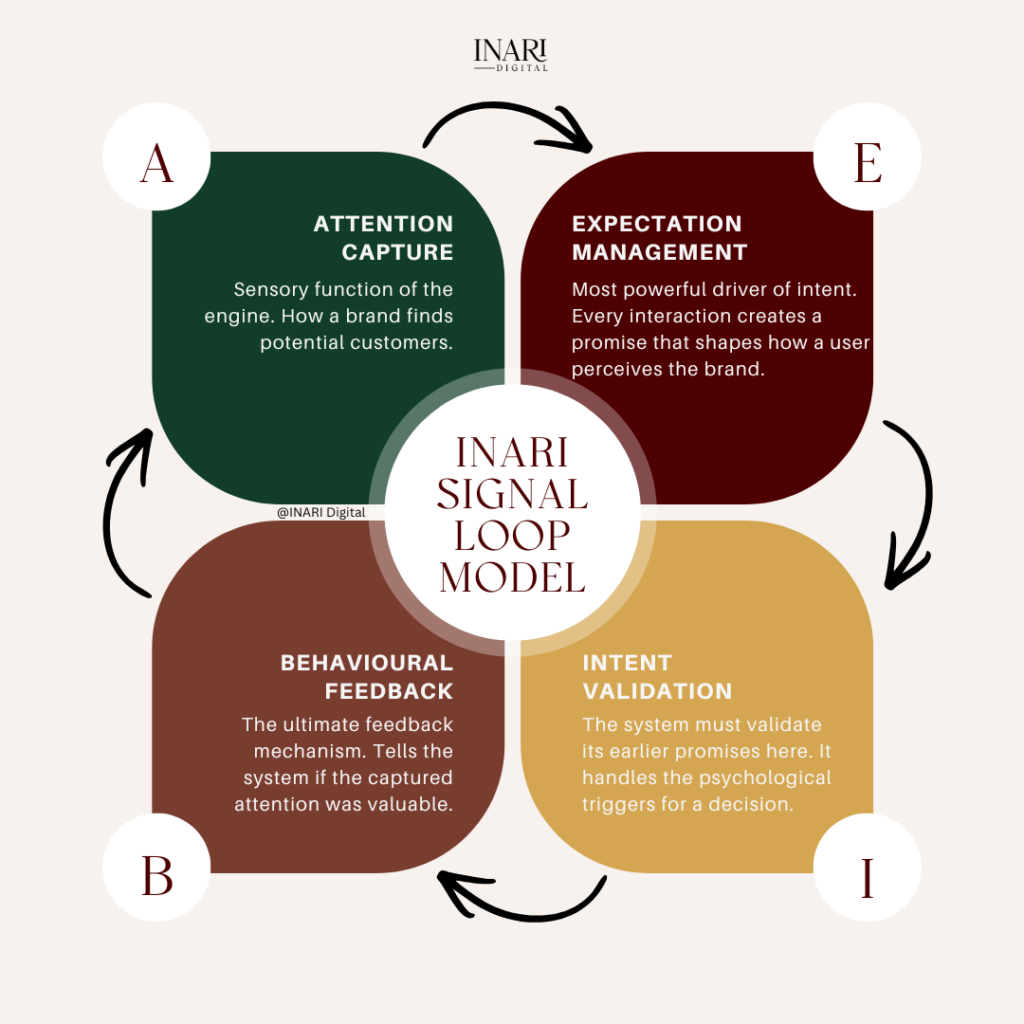
These four layers are not separate silos. They are connected by feedback loops. A marketing system behaves like a living entity. Acquisition quality changes conversion behavior. If you acquire low-quality attention, your conversion rates will drop. As a result, your cost per acquisition will rise.
The lifecycle experience alters media efficiency. A satisfied customer provides data, and this data helps you find similar customers. This is why messaging affects retention. If your ads promise something your product cannot deliver, customers will churn. Every layer is responsible for the health of the others.
The following table illustrates how layers influence one another. A marketing system behaves as an interconnected structure. Each layer directly influences the performance of the others.
|
Relationship
|
Interaction Mechanism
|
Consequence of Failure
|
|---|---|---|
|
Attention to Expectation
|
Messaging sets the user's mental model.
|
High bounce rates and confusion.
|
|
Expectation to Intent
|
Trust in the promise drives action.
|
Low lead quality and conversion.
|
|
Intent to Behavior
|
Frictionless conversion builds early loyalty.
|
Immediate churn and negative sentiment.
|
|
Behavior to Attention
|
Retention data informs future targeting.
|
Rising CAC and wasted media spend.
|
Understanding these connections is vital. It shifts the focus from isolated execution to system connectivity. Only once these connections are visible can fragmentation be properly understood.
When the connections between these layers weaken, the system begins to show consistent patterns of instability. The table below outlines common symptoms felt by marketing leaders. These symptoms suggest a structural issue rather than a tactical one.
|
Symptom
|
Lived Experience
|
Underlying Systemic Cause
|
|---|---|---|
|
Performance Fluctuation
|
Results vary wildly from month to month.
|
Lack of stable feedback loops.
|
|
Cross-Channel Inconsistency
|
One channel wins while others fail.
|
Disconnected data and goals.
|
|
The Efficiency Trap
|
Higher spend produces diminishing returns.
|
Signal distortion in the funnel.
|
|
Strategic Drift
|
Strategy feels like a series of guesses.
|
Absence of an evidence-based verdict.
|
Experienced leaders recognise these patterns. They know that competent execution should produce stability. However, they find themselves in a reactive mode. They respond to symptoms rather than causes.
Fragmentation is not about the number of channels a brand runs or using multiple agencies. Fragmentation occurs when parts of the marketing system operate without awareness of each other. In other words, the feedback loops are broken. The system exists, but it cannot talk to itself.
For instance, acquisition teams often optimise toward cost metrics. They might celebrate a low cost per lead, but lack insight into retention value. They are effectively filling a leaky bucket. Because they do not see the leaks, they keep pouring in water.
Consider SEO teams driving traffic into landing environments. Often, these environments are misaligned with search intent. The user expects a specific answer, but instead they find a generic sales pitch. As a result, the attention layer succeeds, but the expectation layer fails breaking the connection between the two.
Another example is content creation. Content often shapes expectations that the product cannot support. The marketing is brilliant but the reality of the product is disappointing. Customers churn quickly. The retention data exists in a silo that never reaches the content team. The team continues to make the same promises.
Fragmentation means the system has lost its ability to learn. In a coherent system, every failure is a signal. In a fragmented system, failure is just a metric. Teams respond to these metrics by working harder within their silos. They do not realise that the problem is the space between the silos. This is where growth breaks down.
Fragmentation is often confused with complexity. However, they are different concepts. Complexity is a natural part of scaling. A large brand will always have many tools and partners. This does not mean the system is fragmented.
Fragmentation is not defined by how much you do. It is defined by whether the system connects.
When feedback loops are weak, performance signals become distorted. Teams begin to respond to symptoms rather than causes. For example, a drop in leads might lead to a change in ad creative but the real issue might be a broken form on the website. When teams don’t talk, they waste time on the wrong fix.
This distortion creates a cycle of tactical churn. Optimisation increases activity but does not increase stability. The team remains busy, testing new headlines and platforms, yet the month-to-month results continue to fluctuate. They are optimising layers instead of fixing the connections between them.
Fragmentation leads to a decline in media efficiency over time. Acquisition is not informed by lifecycle data. As a result, the marketing team continues to target users who are likely to churn which raises the cost per acquisition. Over time, more spend is required to maintain the same revenue.
Conversion friction is often not communicated upstream. The sales team might notice that leads are confused but the marketing team is only looking at lead volume. What looks like poor traffic quality is actually a lack of communication.
Over time, volatility becomes normalised. The organisation begins to treat instability as inevitable. They stop asking why results are inconsistent and just accept that “marketing is hard.” This acceptance embeds inefficiency. It leads to the acceptance of waste and prevents the organisation from building a truly scalable marketing system.
Fragmentation does not happen because teams are incapable. It happens because modern business rewards specialisation. High-performance teams are often composed of brilliant specialists focused on their own domain. This is how they achieve excellence in a specific channel.
However, this specialisation creates silos. KPIs are often owned separately. The SEO manager is judged on organic traffic. The PPC manager is judged on click-through rates. Neither is judged on the overall coherence of the system. As a result, they naturally optimise for their own metrics. This is rational behavior that leads to irrational system outcomes.
Digital platforms also encourage fragmentation. Google and Meta report in isolation and provide deep insights into their own performance. They do not show how they influence each other. A user might see an ad on Instagram and then search for the brand on Google. Both platforms will claim credit and the marketing team is left with a distorted view of reality.
Agencies are often contracted per channel. A brand might have an SEO agency and a separate social media agency. These agencies are competitors for the brand’s budget and have little incentive to collaborate. Each channel defends its own performance, reinforcing disconnection.
The table below shows why competence doesn’t always lead to coherence. It highlights the structural traps that smart teams fall into. Even highly capable teams can build systems that fail to connect.
|
Structural Trap
|
Mechanism
|
Resulting Fragmentation
|
|---|---|---|
|
KPI Ownership
|
Teams focus on local optima.
|
Overall system performance suffers.
|
|
Platform Silos
|
Data is locked in proprietary tools.
|
Double-counting and attribution errors.
|
|
Contract Silos
|
Agencies work in isolation.
|
Messaging and goals are misaligned.
|
|
Specialisation
|
Deep expertise in narrow fields.
|
Nobody manages the connections.
|
A coherent marketing system shares signals across every layer and functions as a single, intelligent engine. In this environment, acquisition decisions consider retention patterns. The team knows which channels bring in long-term customers rather than chasing the cheapest leads.
Creative reflects real behavioral data. The brand does not guess what customers want to hear. They listen to customer support calls, analyse product usage data and use these insights to shape their messaging. This creates a powerful resonance in the expectation layer and makes the marketing feel personal and relevant.
In a coherent system, conversion insights reshape targeting. If a landing page reveals a common objection, the ads are updated to address it. The system is constantly learning from its own outputs. Media efficiency improves over time, with cost per acquisition stabilising or decreasing.
Lifecycle performance also informs budget allocation. The organisation understands the true ROI of every rand spent. It becomes possible to connect early-stage activity to long-term value. This clarity allows for confident decision-making removing the guesswork from the growth strategy.
A coherent marketing system is defined by its connections. It uses a unified customer data layer that has integrated feedback loops and rewards cross-functional outcomes. It treats marketing as a discipline of learning and the system becomes more effective with every interaction.
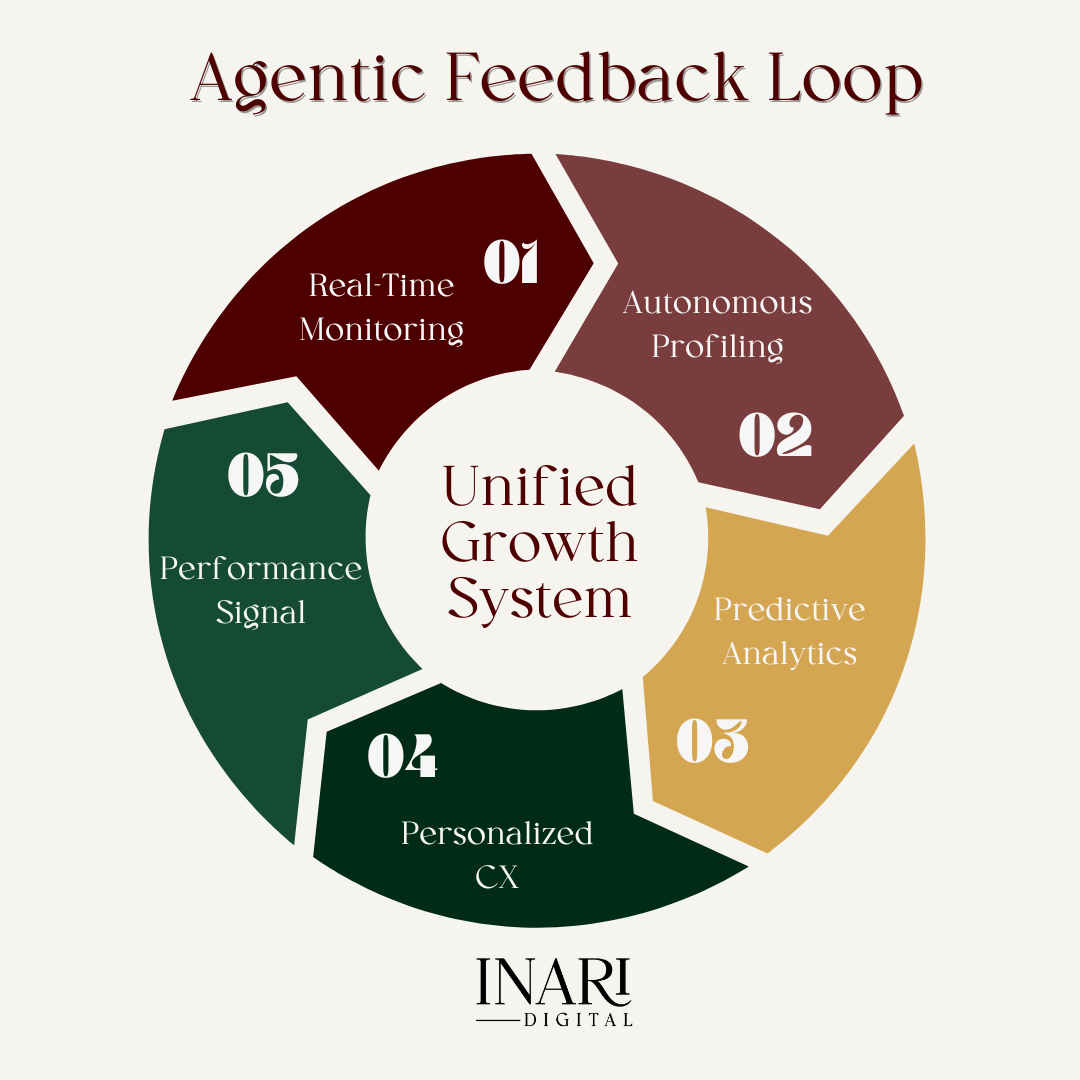
In 2026, AI is no longer a futuristic concept. It is a daily business tool in South Africa. However, the real opportunity lies in how AI connects the marketing system. It is the connective tissue of the modern growth engine.
AI tools allow for personalisation at scale. They can conduct rapid experiments across the customer journey reducing acquisition costs. More importantly, AI maintains system coherence. AI agents can monitor data from many touchpoints at once and detect shifts in behavior that humans might miss.
A new paradigm is emerging: agentic feedback loops. These are autonomous systems that analyse their own performance. They identify patterns and self-improve over time. For example, an AI might notice that users from a specific source are churning. It can then automatically adjust the acquisition targeting.
AI enhances human creativity. It handles repetitive data work freeing the team to focus on the soul of the brand. In 2026, the winners will be those who blend AI efficiency with human empathy. The strongest systems are both efficient and human.
Marketing leaders often confuse strategy with goals. A deck of deliverables is not a strategy. Strategy is a verdict based on evidence. It is the logic that makes the tactical plan matter. In fragmented systems, this distinction is often lost. Strategy becomes a series of hypotheses that are never fully tested.
True strategy survives diagnosis and analysis. It is a deliberate choice of where and how to compete. It is defined before investment begins. When strategy is clear, execution becomes easier. The team knows exactly what they are trying to achieve. They move beyond activity and create progress.
Fragmentation thrives on activity. Teams burn resources on “doing marketing” without a clear objective. This blur breeds waste and guarantees drift. Leaders must separate strategy from goals. Every tactic must serve a single, measurable objective.
Assumptions must be identified and tested. Untested beliefs often contaminate marketing plans. Teams assume they understand the customer and how the market will respond. These assumptions must be treated as risks and validated with data before significant resources are committed.
Coherence requires more than better tools. It requires a culture of execution. This culture is built on transparency. Teams share progress and challenges openly. Failures are treated as signals for the system.
Accountability is also essential. Ownership must be supportive but non-negotiable. Every team member must understand how their work supports the broader system. Clarity of connection is what allows the system to function as a whole.
The transition from a fragmented to a coherent marketing system requires a change in mindset. Leaders must stop looking at marketing as a series of events and recognise it as a continuous system. Every interaction is part of a larger whole. Every customer behaviour is a signal for the next action.
A marketing system either compounds or destabilises. The difference is whether the feedback loops are connected.
Fragmentation is a silent killer of results, and it is entirely structural. By building a connected, coherent marketing system organisations move beyond inconsistent performance and build a growth engine that works as intended.
The problem is not execution. It is structure. Fragmentation is not a performance issue. It is a systems design issue. This is the foundation of how high-performance marketing systems are designed. It is the difference between fragmented execution and engineered growth.
At INARI Digital, this is not treated as theory. It is built into how systems are structured, measured and scaled.
Coherence is engineered.
Most marketing teams don't have a growth problem. They have a design problem. Here's what that distinction means and why it changes everything.
Why marketing feels unstable, what fragmentation really means, and how disconnected systems quietly erode performance over time.
Why most agencies fail to deliver outcomes, and how to choose a partner that owns the full growth system rather than isolated tactics.